
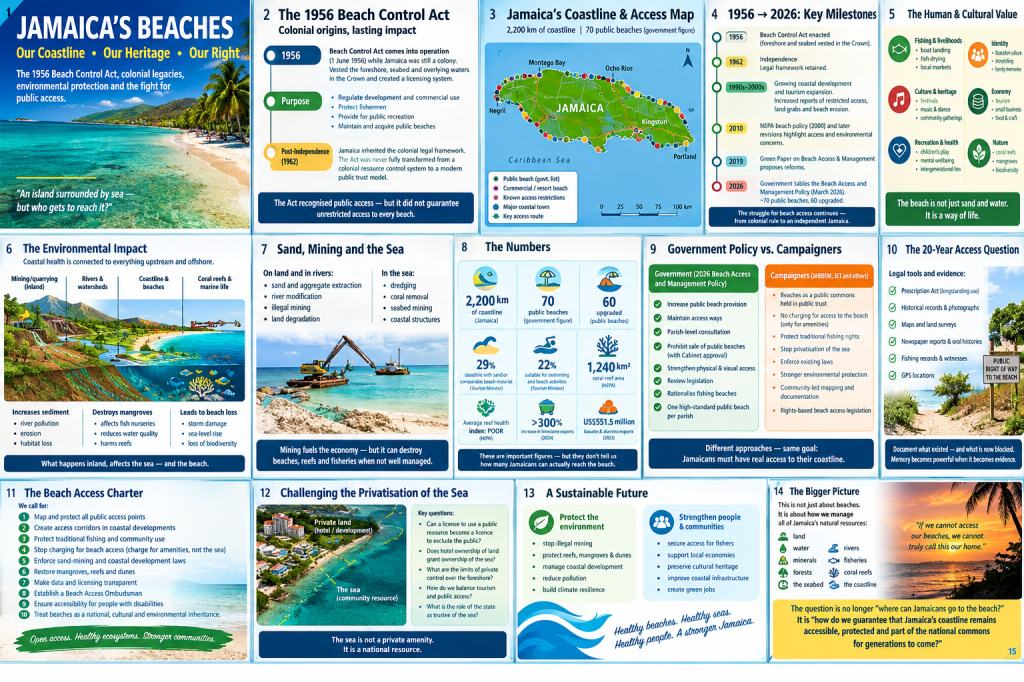
The Beach Control Act came into operation on 1 June 1956, while Jamaica was still a British colony. Its purpose was to regulate the foreshore, beaches, seabed and overlying waters, including commercial development and activities taking place along the coastline. The legislation declared the foreshore and floor of the sea to be vested in the Crown.
The Jamaica Environment Trust has argued that Jamaica’s beaches should be recognised as a public commons held in public trust, rather than treating access primarily as something dependent upon land ownership, licences or government discretion.
The stance of Jamaica Beach Birthright Environmental Movement (JABBEM) is that Crown ownership should be understood in the context of an independent Jamaica as a public trust rather than as something that enables private exclusion. Let’s not forget local people for whom the sea is a lifeline.
When traditional access routes disappear something more than pathways can disappear too.
Protect Jamaica’s coastline as a public, cultural and environmental inheritance while guaranteeing meaningful access to the Jamaican people.”
Public access. Environmental protection. Fishermen’s rights. Fishermen’s rights. Community heritage. Transparent licensing. Responsible tourism. Accountable development. Climate resilience. Fair land governance.
No policy should allow a public natural resource to become effectively private simply because a private company controls the land beside it.
Jamaica does not have to choose between tourism and its people. It does not have to choose between investment and environmental protection. It does not have to choose between hotels and communities.
They face the challenge of gaining strong government commitment and legal support to create a system where development operates within the limits of public interest and environmental sustainability.
Beaches are an economic resource, an environmental resource, a cultural resource and a fishing resource, as well as a recreational resource.
Therefore, this island’s Beaches are part of it’s national identity.
ONE QUESTION BEING ASKED IS:
How do we guarantee that Jamaica’s coastline remains accessible, protected and part of the national commons for generations to come?
Today’s attention to this matter spreads far beyond Jamaica’s coastlines because it includes environmental organisations, community activists, fishermen, residents, legal advocates and campaign groups. JaBBEM has become one of the most visible organisations campaigning for stronger public beach rights.
The Jamaica Environment Trust has also called for Beaches to be treated as a public commons held in public trust.
Beach inna Bondage
The Fight for Jamaica’s Coastline
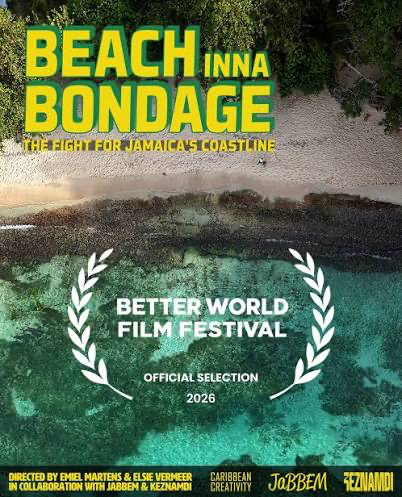
This short documentary provides valuable insight into the impact of severe privatisation of Jamaica’s beaches and highlights the work of a grassroots community fighting to raise awareness and create real tangible sustainable change to preserve the beaches and the environment for generations to come.
The film will provide
- Critical thinking: encouraging students to question assumptions, assess competing interests and distinguish evidence from opinion.
- Interdisciplinary learning: demonstrating how environmental, economic, legal and cultural questions overlap in real-world situations.
- Cultural intelligence: developing a deeper understanding of Jamaican heritage, Caribbean communities and the experiences of people whose voices may be underrepresented in mainstream discussions.
- Employability and professional development: strengthening communication, respectful debate, research, ethical reasoning and collaborative problem-solving skills.
- Global citizenship: exploring the responsibilities of individuals, institutions, businesses and governments in protecting shared natural and cultural resources.
- Community engagement: building constructive relationships between students, academics, local residents and community advocates.
Key Themes and Significance
- Loss of Public Access: The film highlights that less than 1% of Jamaica’s coastline remains publicly accessible to local residents due to decades of commercialisation.
- Colonial-Era Legislation: It scrutinises the 1956 Beach Control Act, a colonial-era law still in effect today that vests control of the foreshore in the state, enabling the state to lease or permit private and foreign corporate enclosure.
- All-Inclusive Tourism Critique: The documentary links the modern all-inclusive resort model to historical patterns of plantation slavery and colonial extraction, arguing that industrialised tourism displaces local communities and disrupts traditional livelihoods.
Currently showing at a location near you, but if you’ve missed it, why not arrange a screening to share the message and raise awareness. Thank you.

